
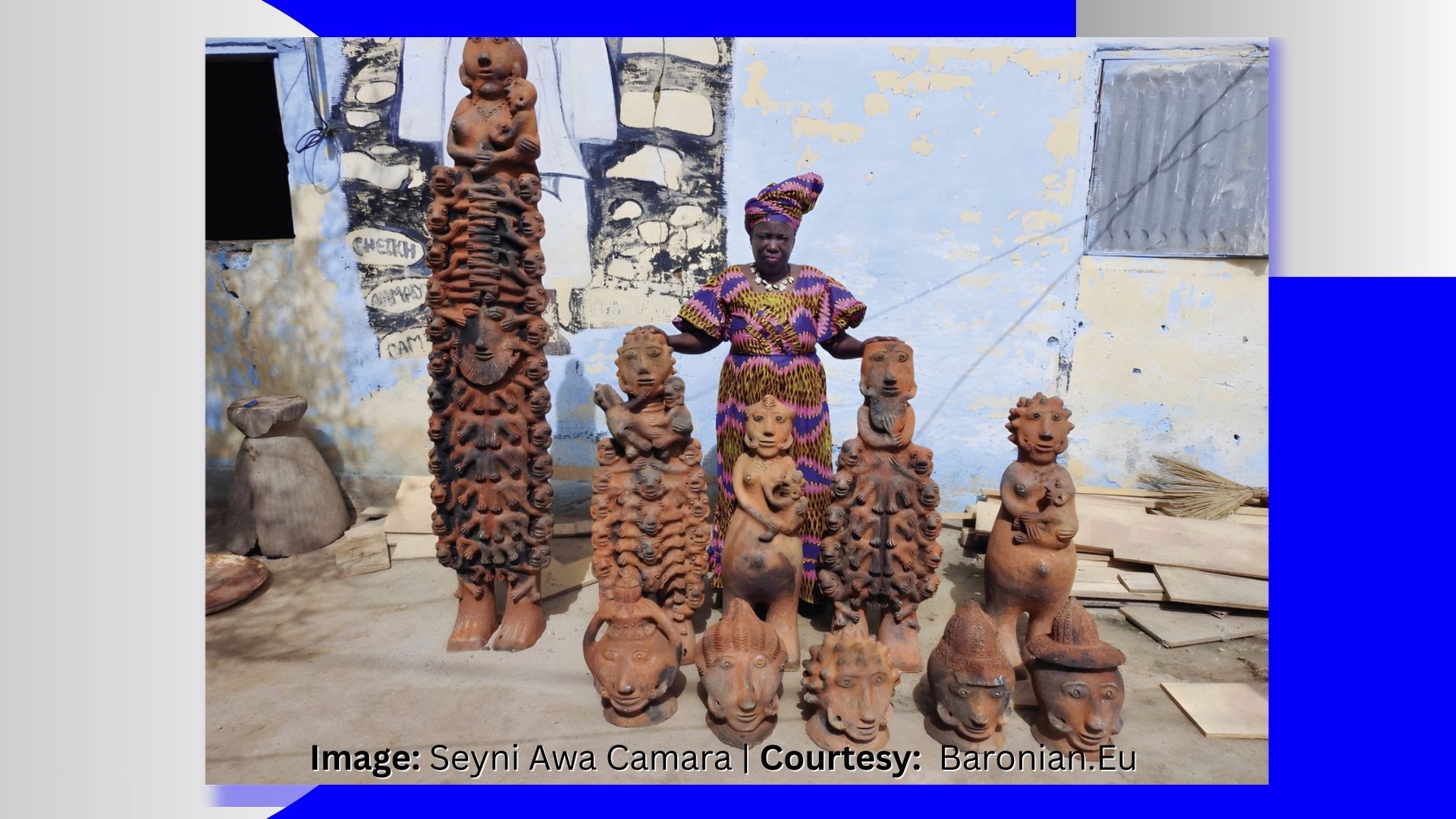
Did We Lose a Matriarch of Sculpture—or a Deity Herself?
With the passing of Seyni Awa Camara, the art world hastily reaches for familiar language: master, matriarch, legend. Yet these words feel insufficient, almost bureaucratic, when confronted with the cosmological weight of her work. To call Camara merely a sculptor is to misunderstand the nature of her practice. She did not represent the world; she summoned it.
Working primarily in clay—earth itself—Camara shaped figures that seem less made than unearthed. Mothers with swollen torsos, multiple breasts, hybrid limbs, and staring, unblinking eyes confront us not as objects of aesthetic contemplation, but as beings with agency. They do not ask to be interpreted. They watch. They judge. They endure.
In many West African cosmologies, the boundary between the human, the ancestral, and the divine is porous. Camara’s figures live precisely in that threshold space. They recall maternity, yes—but not the softened, romanticized motherhood of Western art history. Instead, they evoke motherhood as power, burden, ferocity, and cosmic responsibility. These are not Madonnas. They are creators of worlds and witnesses to violence.
It is telling that Camara’s international recognition arrived late, filtered through the validating machinery of global institutions that often struggle to name what does not fit their categories. Her work was frequently framed as outsider, folk, or intuitive—terms that reveal more about curatorial discomfort than artistic truth. Camara did not sit outside the canon; she exposed its limits.
So when we ask whether we have lost only a matriarch of sculpture or a deity herself, the question is not rhetorical. A matriarch guides a lineage. A deity founds one.
If this was a eulogy, we would say that the passing away of Seyni Awa Camara is a great loss to the art world. She was a matriarch in the world of sculpture, and a creative deity.
Camara leaves behind no school in the academic sense, no manifesto, no disciples. What she leaves instead is more unsettling and more enduring: a pantheon. A body of figures that continue to look back at us, reminding us that African women have always been theorists of form, metaphysics, and power—long before the art world learned how to listen.

Leave a Reply